1992 Antiquated Value: 37% blood flow, more
clot-prone
 |
1992 Market introduction. Installed in CJ
Spence August, 2003.
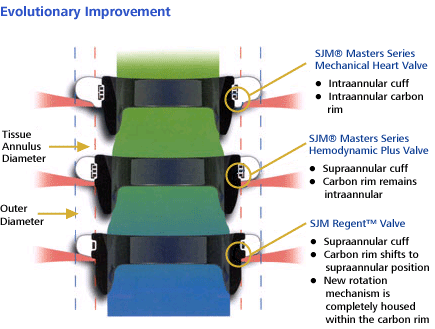
"Also available with the HP Series cuff is a rotatable valve, the
SJM® Masters Series mechanical heart valve, a design that significantly
increases ease of implantation." |
Note: The center bar (above) is not present
in Master and Regent upgrades (below):
1. Deceased blood flow: restricts efficiency
that limits endurance or increases heart rate--lifespan limited from greater
heart stress.
2. Increase surface area of HP valve also increases
stroke-inducing clots.
3. Possible cause of Cathy's arrhythmia, higher blood
pressure and heartrate which constantly drew comments and
concern. |
4. Problems
with documentation, the wallet card gets different answers from St. Judes.
5. Fortunately, Cathy did not receive a Silzone coated
valve which was developed after her HP model (#505 verus 601, 602,
605,701, 706). This numeric recall indicates, from another perspective,
the outdatedness of Cathy's valve.
6. Requires more drugs and thinner blood which causes other
problems.
|
1996: 56% blood flow
 |
1996 Approved for U.S. Distribution:
"In the aortic position, the pivot guards can be rotated toward subannular
obstructions to push them away from the leaflets"
If this later generation valve had been used,
the septal tissue could have been easily and quickly kept away from the valve
leaflets. She would nor have needed a pacemaker, not suffered the hole in
her heart, the Ventricular Septal Defect |
2002: 100% Standard blood flow
 |
2002 Approved for U.S. Distribution: Year before
Spence Heart Surgery
Because of the efficiency of this valve in orifice
to annulus ratio and ease of place, St. Jude doesn't make 17mm version, to
wit, "a two-size increment" (next box text). The smallest available size
is 19mm. The below graph compares the efficiency of the two recent upgrades.
The efficiency of Cathy's old HP valve with a center bar is much
lower. |
 |
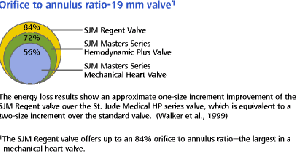
The energy loss results
show an approximate one-size increment improvement of the SJM Regent valve
over the St. Jude Medical HP Series valve, which is equivalent to a two-size
increment over the standard valve. (Walker et al., 1999)
1The SJM Regent valve offers up to an 84%
orifice to annulus ratio--the largest in a mechanical heart valve. |
The antiquated 1992 HP model implanted in CJ Spence is not even listed on
St. Judes website for comparison.
It's efficiency is only 37% of the latest model which is why she is tired
and facing future replacement. |